top of page
Mechanical Engineering

Centrifugal Force Apparatus


Experimental Capabilities :

Determination of relationship between centrifugal force, mass of rotating body and its distance from the axis of rotation at various rotating speed.

​

Hooke's Law


Hooke's law describes the elastic behavior of components whose deformation is proportional to the load acting on it. This behavior is typical of metals under load until reaching the elastic limit.

​

Strut Apparatus


Standard Features :

  1. Designed for desktop use.

  2. Ideal for classroom demonstration.

  3. Rugged structural steel frame.

  4. Applied loading is measured by load cell,

  5. 1 set of specimen struts; mild steel, brass, and aluminum.

​

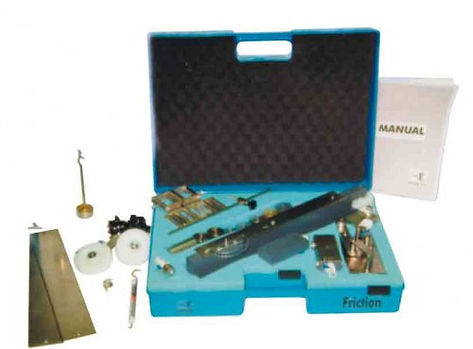
Friction Experiment


​

This module considers the most important phenomenon of Dynamics: Friction. It is a manifestation of the energy loss due to contact, effect that happens in every real-world mechanism.

​

Friction on an Inclined Plane

Experimental Capabilities :

a) Determination of static coefficient of friction of solid blocks and friction plane. b) Determination of kinetic coefficient friction of various materials on friction surface. c) Study of impending-motion condition.

​

Simple Hydraulic System

The Simple Hydraulic System, has been designed to demonstrate how a liquid can be used to transmit a force. The unit can also be used to study the relationships between the force on the plungers, the cross section area of the plungers and the fluid pressure in the system.

​

Computer Controlled Test Bench for Single Cylinder Engines

An internal combustion engine is a machine that transforms, after a combustion process, the chemical energy of a fuel-air mix into mechanical energy.

​

Thin Cylinder Unit

Developed to enable the student to verify the various analytical formulas with actual measured results. Strain gauges mounted in various positions on the cylinder provide an opportunity for students to interpret the strains for a biaxial stress system.

​

Computer Controlled Exhaust Gas Calorimeter


This Computer Controlled Exhaust Gases Calorimeter is a suitable teaching equipment to measure the heat contained in the exhaust gases of an engine.

​

Dynamometer and Controller

To demonstrating how the dynamometer and controller work, and how to maintain the typical dynamometer. The students are allowed to learn more about the following topics : a) Determination of indicated, friction and brake power. b) Determination of engine performance curves, mechanical efficiency and A/F ratio. c) Determination of brake specific fuel consumption and indicated specific fuel consumption.

​

Deflection of Beams and Cantilevers

Standard Features :

  1. Rigid aluminum structural frame..

  2. Design for desktop use.

  3. Equipped with following accessories : 1 set of digital dial gauge, 2 set of point load, adjustable, 2 set of horizontal scale, 1 set of steel, brass and aluminum beam as specimens.

​

Cam Analysis Unit

The Cam Analysis Unit allows to observe the effect of the profile of a cam, the study of the displacement, velocity and acceleration profiles of the cam and the identification of the factors that can modify the dynamics of the cam.

​

Epicyclic Grear Unit


The function of an automatic transmission is to change gears automatically without any human intervention. Automatic gearboxes have two differentiated parts: the torque converter and the transmission.

​

Coriolis Force Demonstration Unit


The Coriolis Force Demonstration Unit, is used to observe the deflection of a jet of water generated by a pump attached to a rotating arm that rotates to different speeds in a horizontal plane.

​

Static and Dynamic Balancing Unit

A unit to study and analyze the oscillations and vibrations and how to eliminate or diminish them.

Overdrive Unit


Automatic transmissions perform speed change operations automatically without the human factor intervention. Automatic gear boxes have two different parts: the torque converter and the transmission.

​

Winch Mechanism


The Winch Mechanism, allows to demonstrate the principle of a winch and its behavior and to study different terms (transmission ratio, unwinding speed, angular speed, efficiency) concerned to the winch.

​

Unsymmetrical Cantilever Unit

Designed to demonstrate the unsymmetrical bending of beams. Simple experiments may be carried out to determine deflections at the free end of cantilevers of different sections for varying angles of applied load from which the relationship between ∆u /W and ∆v /W may be determined graphically.

​

Beam Deflection Unit

This unit has been designed to enable the students to observe and study the following phenomena in simply supported beams and cantilever beams: - Relation between the deflections and the applied loads. - Effect of the length and the cross section on the beam behavior

​

Worm and Wheel Unit


This unit allows the study of the torque and in determining the efficiency and the transmission ratio of a worm gear.

​

Scotch Yoke Mechanism


This unit is an example of slider-crank mechanism, for converting the linear motion of a slider into rotational motion or vice versa. The rotating motion of the crank generates the alternative linear motion of the piston. It is a reversible system.

​

Acceleration of Geared System Unit

It allows to perform tests to calculate the moment of inertia of a gear train system. Two of its six gears can have another position in the shafts to vary the gear ratio, allowing to obtain a different moment of inertia.

​

Free and Forced Vibration Unit

The Free & Forced Vibration Unit, has been developed to cover a range of demonstrations and experiments which provide the user with an understanding of the free and forced vibrations of a simple spring-mass-damper system.

​

Slotted Link Mechanism

This mechanism is a combination of an inversion of the slider-crank chain and slider block. The unit is assembled in an anodized aluminum profile structure, with steel painted panel.

​

bottom of page